
The Shivendra Sinha National Theatre Festival 2026 emerged as an important and distinctive initiative in Patna’s theatrical landscape. Organised jointly by House of Variety and Dastak, Patna, with the support of Bihar Gramin Bank and the Department of Art, Culture and Youth, Government of Bihar, the festival brought together several distinguished theatre groups and diverse theatrical traditions from across the country for audiences in Patna over three months, from August to October.
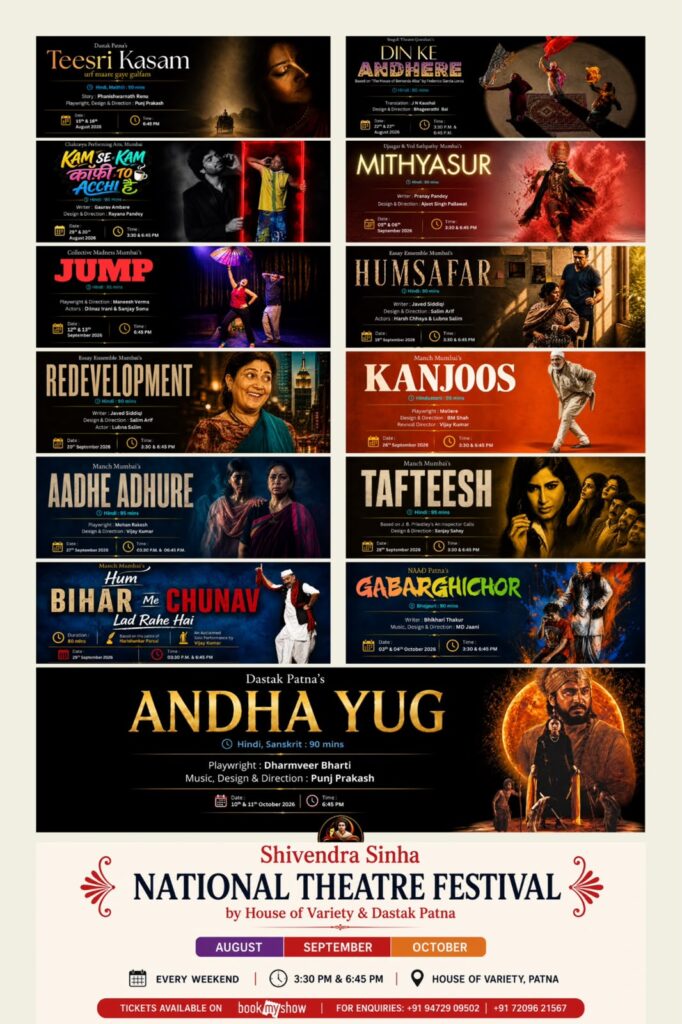
The festival’s significance lay not only in the diversity of its productions but also in its weekend-based schedule and ticketed format. The encouraging response from audiences who purchased tickets to attend the performances demonstrated that Patna has an audience for quality theatre. The substantial attendance at several productions also challenged the widespread perception that audiences in Hindi-speaking regions are reluctant to buy tickets for theatre performances.
In this sense, the festival was more than a series of theatrical productions. It represented a significant effort to cultivate an active, audience-centred theatre culture in Patna.
From Remembrance to Active Theatre
The festival is named in memory of the senior theatre practitioner Shivendra Sinha. Born on 23 January 1933, he earned an MA in Psychology with first-class honours from Patna University. He received a Diploma in Dramatic Art from the University of London and underwent training at RADA and the British Drama League. He passed away on 7 April 2003.
Shivendra Sinha was among the rare Indian cultural practitioners who served as an important bridge between Indian and international theatre. After receiving professional theatre training, he worked extensively in theatre and television in Britain, gaining recognition for his acting and theatrical experience. On returning to India, he expressed social and human concerns through film direction. His creative journey spanned three mediums: theatre, television and cinema.
His association with Kissa Kursi Ka, in particular, remains an important chapter in the history of Indian cinema. Shivendra Sinha’s contribution extended beyond acting, writing and direction; he also helped place the modern sensibilities of Indian theatre and cinema within a broader cultural perspective.
Organised in recognition of his commitment to theatre and his creative contributions, the festival does more than pay tribute to his memory. It connects his legacy with active theatrical practice. A total of 13 productions featured theatre organisations from Patna, Mumbai and Guwahati.
A Platform for Diverse Theatrical Languages
The festival opened with Dastak, Patna’s production of Teesri Kasam Urf Mare Gaye Gulfaam. Conceived, written and directed by Punj Prakash, the production drew inspiration from the stories of Phanishwar Nath Renu, Shailendra’s film Teesri Kasam, the songs of Gulab Bai and the devotional songs of Kabir. Centred on rural life, folk culture and love, the production established a dialogue between literature, cinema, folk music and theatre.
Din Ke Andhere, presented by Seagull Theatre, Guwahati, was based on Federico García Lorca’s world-renowned play The House of Bernarda Alba. Directed by Bhagirathi Bai, the production explored questions of female identity, social control and domestic oppression.
Lorca’s celebrated play The House of Bernarda Alba centres on patriarchy, the oppression of women, social conventions and the struggle for personal freedom. Following her husband’s death, Bernarda Alba imposes strict discipline and rigid social codes on her five daughters, suppressing their desires and aspirations. The play is a powerful tragedy of conflicting forces—oppression, authority, desire, jealousy and the human yearning for freedom.
Kam Se Kam Coffee Toh Achchhi Hai, presented by Chakravyuh Performing Arts, Mumbai, gave voice to the dreams and insecurities of young people struggling to find a foothold in Mumbai’s film industry. Meanwhile, Mithyasur, by Ujaagar Dramatic Society, explored mythology, faith, power and truth through its distinctive theatrical language.
Mithyasur establishes a dialogue between mythology and contemporary reality. Its themes revolve around falsehood, deception, power and the changing moral consciousness of human beings. By examining the spread of falsehood and its consequences for social life, the play raises questions about the relevance of truth.
Jump, written and directed by Manish Verma of Collective Madness, Mumbai, was another notable production. Featuring Dilnaz Irani and Sanjay Sonu, the play explored urban loneliness, success and human connection through two characters from contrasting social backgrounds.
A sensitive and deeply human work, Jump addresses life’s crises, loneliness and existential questions. Through a conversation on the rooftop of a high-rise building, the play reveals the profound isolation that can lie behind success. It also suggests that even a brief conversation with a stranger can sometimes transform the way we look at life.
From Veteran Theatre Practitioners to Folk Theatre
In September, Humsafar and Redevelopment, directed by Salim Arif, enriched the festival with the presence of veteran theatre practitioners. Featuring poems by the celebrated poet Gulzar, written by Javed Siddiqui and performed by artists such as Harsh Chhaya and Lubna Salim, the productions respectively explored relationships and memories, and the issues of urban development and displacement.
Among the productions presented by Manch Mumbai was Kanjoos, directed by renowned theatre guru B. M. Shah. Inspired by The Miser, the celebrated comedy by French playwright Molière, the play portrayed the familial and social contradictions arising from excessive attachment to money and extreme miserliness. Through humour and satire, it exposed the tensions between greed, the obsession with wealth and human relationships.
Mohan Rakesh’s Aadhe-Adhure examines tension, dissatisfaction, loneliness and growing emotional distance within a modern middle-class family. Through Savitri and her family, the play explores unfulfilled aspirations, an unsuccessful marital relationship and emotional insecurity. It exposes the irony of middle-class life, in which individuals remain perpetually incomplete in their search for fulfilment.
Tafteesh, directed by Sanjay Sahay, a distinguished literary figure and editor of Hans Prateek, offered a distinctive theatrical experience. The production was based on J. B. Priestley’s celebrated play An Inspector Calls.
Priestley’s An Inspector Calls explores social inequality, class divisions and human responsibility. Through the arrival of a mysterious inspector, the play gradually exposes the selfishness, insensitivity and social exploitation concealed within a prosperous family. It demonstrates that every individual is accountable for their actions and for the impact those actions have on the lives of others.
Vijay Kumar’s acclaimed solo performance Hum Bihar Mein Chunav Lad Rahe Hain, based on a satirical work by Harishankar Parsai, brought social and political satire to the stage. The performance offered a sharp, witty and entertaining theatrical intervention into Bihar’s political and social contradictions.
Through solo acting, it effectively portrayed electoral politics, power, caste equations and the aspirations of ordinary people. With more than 1,050 performances over nearly four decades, the production stands as remarkable evidence of its popularity, enduring relevance and theatrical impact. Its distinctive identity lies in its ability to present the ground realities of contemporary Bihar through humour and satire.
The productions presented by Manch Mumbai were powerful examples of how maximum theatrical impact can be achieved with minimal resources. Despite their limited means, their innovative theatrical languages, compelling performances and skilful presentation demonstrated that the true strength of theatre lies not in an abundance of resources but in the imaginative, committed and creative use of what is available.
The festival also featured Gabarghichor, the timeless play by Bhikhari Thakur, presented by Naad, Patna. Through folk language, songs, music and humour, the play explores questions of love, marriage and paternity within Bhojpuri rural life. It powerfully exposes contradictions surrounding women’s freedom, social morality and the patriarchal order.
Its accessible folk-theatre form and profound social vision make Gabarghichor a compelling representation of Bihar’s rich folk-theatre tradition and its continuing relevance in contemporary society.
The festival concluded with Dastak, Patna’s production of Andha Yug. Punj Prakash developed a new conceptual interpretation and directed this celebrated verse play by Dharamvir Bharati.
Set in the aftermath of the Mahabharata war, the production explored violence, power, moral crisis and the darkness within human beings. Its notable features included the actors’ clear and precise pronunciation of formal Hindi and Sanskrit, the powerful delivery of dialogue, and costume and music conceived to suit the dramatic atmosphere and emotional landscape.
The distinctive theatrical vision of Dastak and Punj Prakash—marked by a new theatrical language, experimental stagecraft and a modern interpretation of traditional narratives—was effectively reflected in Andha Yug as well.
Ticketed Theatre and the Growth of Audience Culture
One of the festival’s most significant features was its commitment to ticketed theatre, complemented by a diverse programme and a professional approach to presentation. The sustained and enthusiastic attendance across performances indicated that audiences are willing to purchase tickets and support theatre when productions demonstrate quality, credibility and the ability to establish a meaningful connection with them.
This is particularly significant in a city like Patna, where theatre has long faced questions concerning audience numbers and financial sustainability. The festival offered an encouraging indication that a viable economic relationship between theatre and its audiences can be developed.
From Local Theatre to National Dialogue
The festival’s greatest achievement lay in its diversity and reach. Theatre practitioners from different generations, organisations from various cities and a wide range of theatrical styles came together on a common platform. Literary adaptations, contemporary plays, folk theatre, solo performances and classic works collectively presented a broad picture of the theatrical landscape.
The participation of theatre practitioners such as Bhagirathi Bai, Vijay Kumar, Harsh Chhaya, Salim Arif, Lubna Salim, Sanjay Sonu, Dilnaz Irani, Punj Prakash, Manish Verma, Ajit Singh Pallawat and Ipshita Chakraborty connected the festival with a wider national theatre scene.
The presence of distinguished personalities from literature and culture, including Sanjay Sahay, Suman Sinha, Shrikant Kishore and Hrishikesh Sulabh, further enhanced the stature of the event.
In this way, the performances in Patna extended beyond local theatrical activity and became a medium of dialogue with theatre traditions from other parts of the country.
The Beginning of a New Possibility
A theatre festival should not be evaluated solely by the number of productions it presents, but by what it contributes to the theatrical culture of the city that hosts it. Judged by this criterion, the Shivendra Sinha National Theatre Festival 2026 represents an important beginning.
A three-month programme, 13 productions, theatre groups from different cities, diverse theatrical languages and audiences willing to purchase tickets collectively brought into focus the possibility of developing a more regular and audience-centred theatre culture in Patna.
Connecting the memory of Shivendra Sinha with active theatrical practice lends additional significance to the festival. The joint initiative of House of Variety and Dastak, Patna, is noteworthy because it seeks to view theatre not merely as an event, but as an ongoing cultural dialogue with society.